
Contributing authors Pernilla Sörme & Scott Weitze, My Green Lab, Divya Varaharajan, Scivalon
Artificial intelligence (AI) is rapidly transforming research in chemistry. Many stages of the discovery process, from literature review, molecular design, property prediction, retrosynthetic planning, experimental design, data analysis, and interpretation are benefiting from acceleration opportunities offered by the integration of AI. Adoption has been particularly strong in analytical chemistry and the molecular life sciences, where large and complex datasets are common. Many scientists from other fields are also exploring how to effectively integrate AI into their routine practices and research to enable faster potential real-world impacts (Jelfs, 2025).
AI and Sustainability
AI also comes with potential positive and negative consequences for the environment. AI can help to develop more sustainable chemistry, particular by being directed to align with the 12 principles of green chemistry. These principles focus on reducing waste, increasing the energy efficiency of reactions, and minimising the use of hazardous reagents. Outcomes that lead to more efficient and more sustainable chemistry strongly highlight the value of AI as a supporting tool.
AI has already advanced the implementation of green chemistry principles in several areas. For example, researchers have used AI to facilitate greener solvent selection by analysing and clustering solvents according to their physical properties, enabling more informed choices based on environmental, health, and safety criteria (Sels, 2020). AI has also been applied to optimise reaction conditions, reducing the number of experiments required when compared to traditional trial-and-error approaches (Kwon, 2022).
But AI also has a rapidly growing environmental footprint from the associated need for increased computational power, large numbers of data centres, and increasing hardware requirement including semiconductors. The full lifecycle impacts of AI must therefore be carefully managed to support reducing, rather than merely shifting, the associated environmental burden.
Many researchers use large language models (LLMs), which includes ChatGPT, Claude, Gemini, Microsoft Copilot, and others. Training and deploying LLM-based AI models requires significant computational resources, leading to increased energy consumption, land use, water usage for the cooling of data centres, and raw material extraction and depletion to meet increasing demand for hardware. Hardware often includes cobalt and tungsten, which are considered ‘conflict minerals’ (Luccioni, 2024). Globally, data centres are projected to use 945 TWh of electricity by 2030 (IEA, 2025), and one recent study estimated that data centre expansion could increase total CO₂ emissions from the United States by ~2% by 2030 (Jha, 2025).
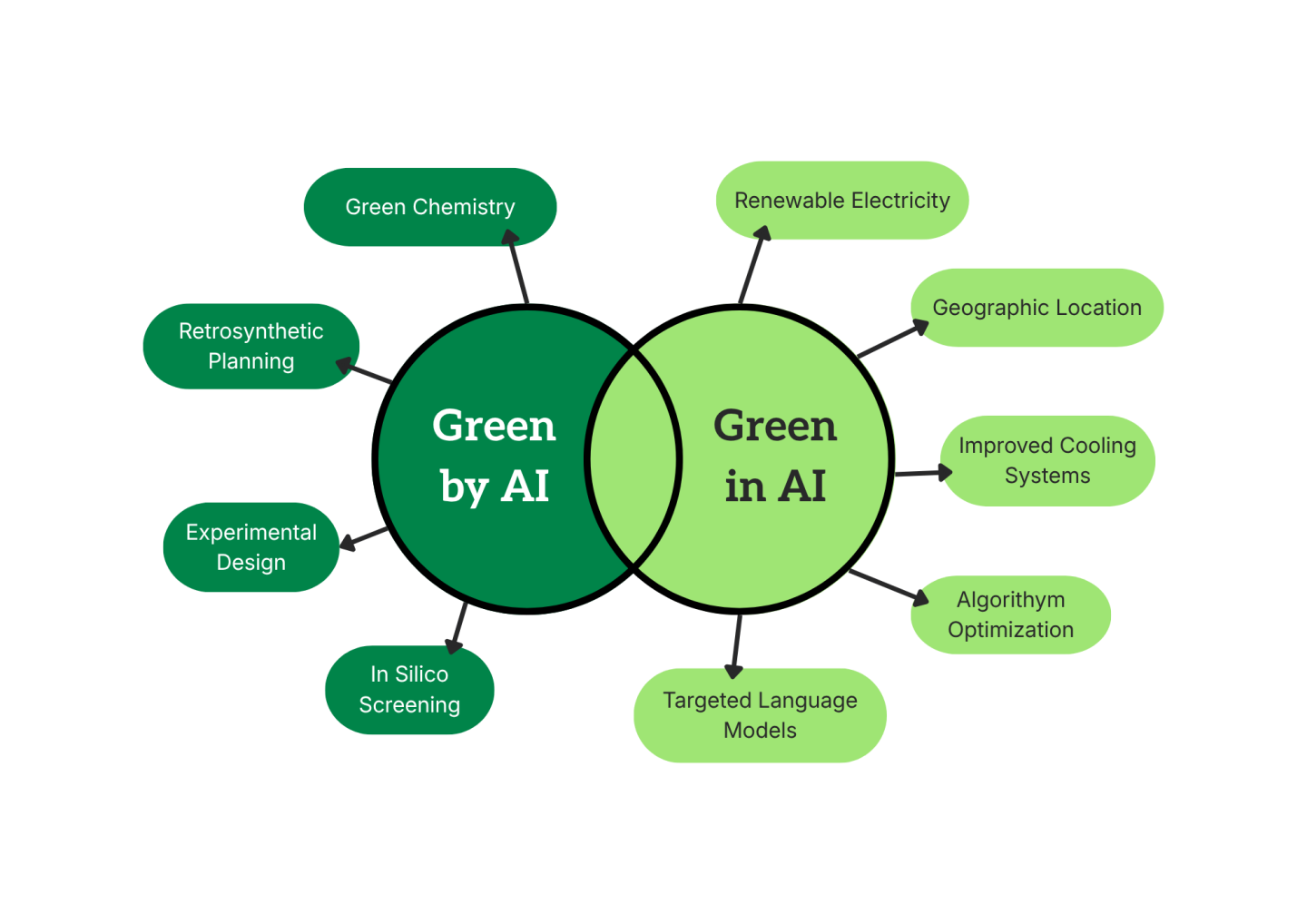
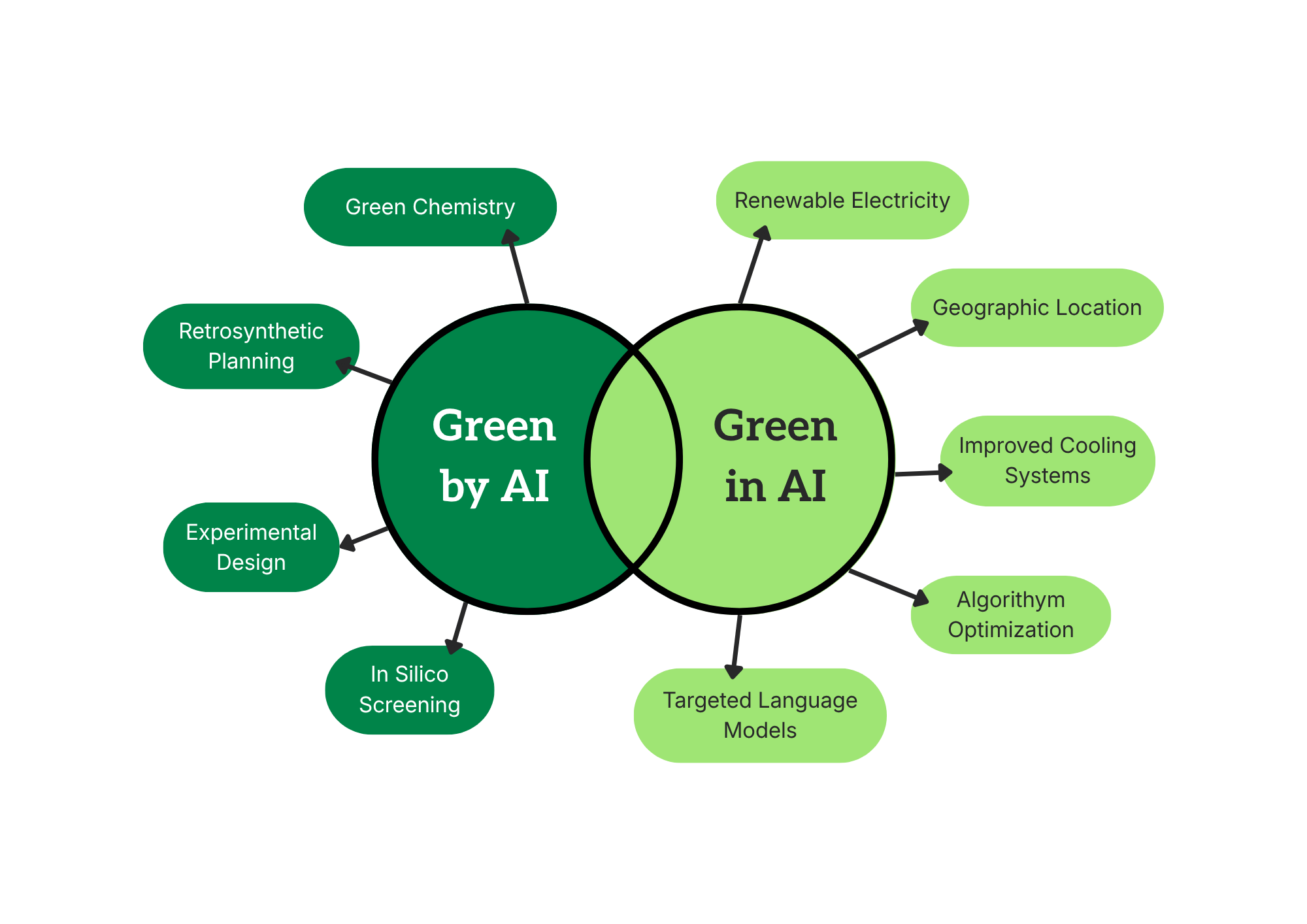
However, there are opportunities to support reduced environmental impact by using AI for specific research outcomes, a “Green by AI” approach, and improving how data is used, a “Green in AI” approach (Figure 1), and certain projects that can do both.
Data Centres and Greener AI
Improvements that data centres can make to ensure greener AI include better energy sourcing and designing for reduced water consumption and improved cooling. Transitioning to low‑carbon or renewable electricity sources and locating data centres in low‑carbon geographical regions are both amongst the most effective ways to reduce the greenhouse gas (GHG) emissions associated with AI infrastructure. This pathway is also clearly available for global improvement, as in 2025 less than 20% of worldwide data centres were powered by renewables (Greenfield, 2025). Another important aspect is the cooling of data centres. Improvements in cooling system design can reduce energy used for cooling by 50% (Patel, 2025). More broadly, system-level strategies such as integrating waste heat recovery can further reduce the environmental footprint of a physical data centre.
Human Choices and Language Models
There are also choices lab members can make to support greener AI, including selecting for optimised algorithms that require less computing power, using energy efficient hardware, and choosing AI providers with more sustainability-focused data centres. While the ability to choose and use a specific data centre is often limited, when the option is available researchers who are using cloud-based platforms can reduce emissions by selecting data centres in a geographical region with lower carbon intensity of the relevant utility grid due to a higher amount of renewable energy use. To demonstrate one example, the carbon footprint to produce 1kWh in Australia as compared to Switzerland is over 70-fold larger due to the use of coal and natural gas in Australia (Schilter, 2024).
Another area of focus can be evaluation of the data set your AI tool is using. Large Language Models (LLMs) are powerful AI systems trained on vast datasets with billions of parameters, enabling broad, general-purpose tasks that rely on significant energy input to data centres. In contrast, Small Language Models (SLMs) are more condensed and specialised, requiring far less computational power and therefore less energy. SLMs can also be decentralised and use a local small data server dedicated to a particular purpose and support. Even when still relying on non-local data centres, fine-tuned SLMs for predefined tasks are typically more energy- and cost-efficient.
Comparing LLMs to SLMs for Sustainability
Large generative AI models are trained and deployed on energy-hungry servers in warehouse-scale data centres, accelerating energy consumption by data centres at an unprecedented rate. A life cycle assessment (LCA) study of the BLOOM Large Language Model, which uses 176 billion parameters, estimated total GHG emissions of 50.5 tonnes CO₂eq were attributable directly and indirectly to the model training process, equivalent to driving a petrol/gas car around the Earth five times. Approximately 49% of the emissions came from the model training itself through energy consumption, while 29% was due to idle operations from the data centre with energy from cooling/heating, networking, and storage, and the remaining 22% from manufacturing of the GPU chips (Figure 2). This study extended previous studies in considering all stages of the AI model creation and use, with raw material extraction, manufacturing, model training, model deployment, and disposal/end-of-life. The carbon impact from AI was determined to be almost double the impact estimated in previous studies that only examined the LLM training in isolation (Luccioni, 2023).

Large amounts of freshwater are also consumed for the cooling of servers that support AI systems. It is estimated that for training GPT‑3 in Microsoft-operated U.S. data centres 5.4 million litres of water were consumed, with approximately 700,000 litres (13%) as direct onsite cooling water and the remaining water considered as indirect consumption for generating electricity. It is also estimated that generating 10-50 medium length ChatGPT responses may consume approximately 0.5 litres of water, depending on the location and timing of deployment (Li, 2025).
Recent analyses of state-of-the-art models such as GPT-4, Claude, and DeepSeek indicate that water consumption remains a significant sustainability concern during model deployment and inference, particularly when scaled across hundreds of millions of daily actions (Jegham, 2025).
An average data centre, supporting LLMs and also cloud computing services such as data storage, web hosting, enterprise software, and streaming platforms, can use around 2.1 million litres of water per day. And some facilities are located in water-stressed regions, such as the deserts of Arizona in the United States, where electricity may be readily available, but water resources are limited (DGT Finance, 2024).
Data centres and associated LLMs also carry substantial environmental impacts from land use, and infrastructure for hardware manufacturing plus critical material extraction, the high chemical-intensity of semiconductor manufacturing, and the production of electronic waste.
In response to this environmental impact, the EU now requires providers of general-purpose AI models to document energy consumption, and supports improved resource efficiency, creating increasing pressure to ‘right-size’ models in line with their intended use (EU AI Act, 2024).
Table 1: Environmental footprint of language models, comparing large and small data sets (Greenfield, 2025).
| Metric | SLM (Small Language Model) | LLM (Large Language Model) |
| Training Energy | 50-70 MWH (Mistral-7B) | 1, 287 MWh (GPT-3) |
| Energy per query | 0.00006–0.0003 kWh | 0.0003–0.001 kWh |
| Water per query | <0.1 mL (device-based, lower) | 0.25–5 mL |
| CO₂ emissions per query | 0.1–0.5 g CO₂e per query | 2–5 g CO₂e per query |
| Deployment | On-device (e.g., mobile phones) | Cloud based, data centres |
SLMs such as Phi-3, Gemma-2B, and Mistral, are faster and more efficient, and it has been estimated that smaller models can reduce energy consumption by up to 90% through using more focused data sets and task-based SLM training (UNESCO, 2026).
SLMs also may require no new hardware and can be deployed immediately by users (Barros, 2025). This adds a circular economy dimension to the use of SLMs, as their lower computational requirements allow them to run efficiently on older or less specialised hardware, thereby extending equipment lifetimes. This reduces the need for frequent hardware upgrades, supporting a more sustainable use of digital infrastructure (Greenfield, 2025).
A growing wave of startups and research groups are developing domain-specific SLMs tailored for distinct scientific disciplines. These models have been shown to often outperform the results of general purpose LLMs, as they are built for depth and consistency rather than broad coverage. Efforts from ChemBERTa, ChemLLM, OmniScience, and Scivalon’s Vivian are being developed specifically for chemistry and other scientific applications, similar to earlier developed foundational models like BloombergGPT for finance and Galactica for scientific knowledge. Trained on specialised datasets, these models are designed to capture the terminology, ontologies, and accuracy requirements of their respective fields, enabling them to include nuances that general-purpose LLMs may overlook. This could also address challenges with using general LLMs for rigorous scientific work, where generic training and hallucination may make results less reliable (Bonenkamp, 2026).
To reduce the environmental impact of AI going forward while maintaining quality, a hybrid approach is emerging where inexpensive and accurate SLMs are used for the bulk of queries, with escalation to LLMs only as needed for multi-model tasks. This approach with SLMs relies on matching the most appropriate model to each task, rather than relying on a single large, general-purpose system for everything (Greenfield, 2025). With current trends, it is predicted that by 2027 more than half of the generative AI models used by organisations will be domain-specific SLMs, compared with just 1% in 2024, reflecting the increasing demand for models built for specific scientific disciplines (Gartner, 2025).
Conclusion
AI is reshaping chemistry by enabling faster, more efficient research and can be used to support greener practices and discoveries. However, the environmental footprint of AI is significant, making responsible implementation of AI, including the use of smaller, more efficient models, essential. Ultimately, AI can both reduce and contribute to impacts on the environment, and these trade-offs must be carefully considered and balanced.