
Co-authored by My Green Lab and Evergreen Bioscience Innovation Cluster
Healthcare exists to protect human health, yet the sector contributes nearly 5% of global greenhouse gas emissions. Closing the gap between healthcare’s mission and its environmental footprint is one of the defining challenges facing healthcare and the life sciences. It is also a shared opportunity. Many of the most effective sustainability strategies can reduce emissions, lower costs, strengthen resilience, and improve performance at the same time. But progress will not come from any single organization acting alone. It will come from people, companies, institutions, and communities willing to work together, confront the challenge directly, and build a positive vision for the future that others can help carry forward.
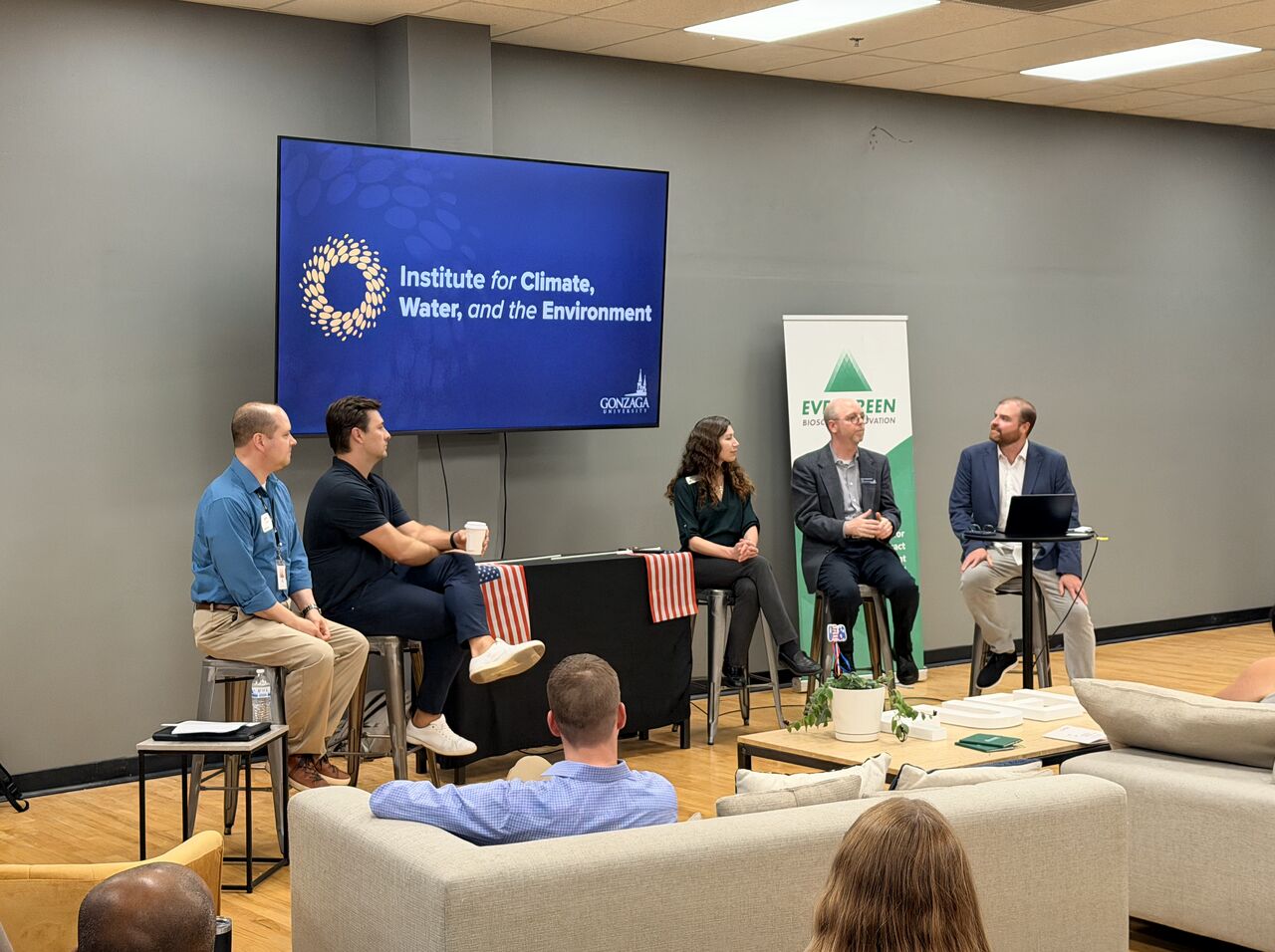
On June 30th, one of those communities gathered in Spokane. Leaders from across the region’s healthcare, life science, sustainability, and economic development sectors came together at Fuel Coworking for Local Action, Global Impact: Sustainability in Life Sciences and Healthcare, an event co-hosted by My Green Lab and the Evergreen Bioscience Innovation Cluster as part of their ongoing partnership to accelerate sustainable laboratory practices throughout the Inland Northwest. Together, the organizations are building a regional ecosystem where startups and established life science companies can adopt sustainability practices that improve both environmental performance and business competitiveness.
Climate change is a health issue
James Connelly, CEO of My Green Lab and Impact Laboratories, did not just begin with a slide; he began with a story. As a child, weekends hiking and camping across Eastern Washington and Northern Idaho with his mother, a single mother and schoolteacher, gave him a lasting appreciation for the natural world and ultimately shaped his career in sustainability. Today, many of those same places are increasingly affected by wildfire smoke, extreme heat, and other climate-related challenges. Climate change is no longer only an environmental issue; it is a direct and growing threat to human health that is affecting lives across our region every day.
The rest of the presentation made that case with data. Climate change is already shaping health outcomes around the world, from increased disease burden and supply chain disruption to rising operational costs and system strain. Healthcare’s own footprint creates both a responsibility and an opportunity, because many of the most effective sustainability initiatives reduce emissions, lower costs, and strengthen resilience all at once.
James outlined a practical path for reducing the environmental impact of healthcare and life sciences, beginning with a hopeful reminder that, despite recent political backlash in the U.S., the sector is increasingly embracing sustainability and climate action. He then moved from the broader industry context to specific strategies that healthcare systems and life science companies can implement to reduce emissions, strengthen resilience, and improve performance. He also emphasized the central role of laboratories, which are often the operational heart of life science organizations and can consume up to five times more energy than standard office space. Finally, he closed with a call to action, urging organizations to align with global initiatives such as the UN Race to Zero and My Green Lab Certification to create consistent expectations across value chains and drive measurable, system-wide impact.
Four perspectives, one region
The panel brought the conversation home to the Inland Northwest.
Dr. Brian Henning, Director of the Gonzaga Institute for Climate, Water, and the Environment, made the case that climate change is fundamentally a health issue, with real consequences for communities across the region. For Ryan Arnold, Regional Business Manager at Avista, the connection runs through operational resilience and the bottom line, where energy challenges become opportunities for healthcare facilities to improve efficiency and reduce costs.
Dr. Michaele Armstrong, Executive Director of the Evergreen Bioscience Innovation Cluster, spoke to why sustainability must be built into emerging companies from the start, as workforce, customer, and investor expectations continue to rise, and what that means for Spokane’s growing bioeconomy. Jeff Yirak, Mechanical Engineering Principal at McKinstry, kept the discussion practical, highlighting smart facility design, commissioning, and optimization strategies that reduce emissions while improving building performance.
All panelists made one thing clear: sustainable healthcare and life sciences are not abstract goals. They are operational, financial, and community health priorities that can be acted on now.
“I think health professionals, particularly on a global basis, recognize that it’s about the health of our communities and the health of our planet, not just care and treatment of patients.” – James Connelly, CEO, My Green Lab and Impact Laboratories.
One of the strongest themes of the day was that sustainability is easiest—and most affordable—when it is built into organizations from the beginning. Through Evergreen Bio’s business incubator, startups now have access to My Green Lab resources that help them establish efficient laboratory operations from day one. This includes practical guidance on reducing energy consumption, minimizing laboratory waste, selecting sustainable purchasing practices, and training employees to operate laboratories more efficiently. These practices not only reduce environmental impact, but also lower operating costs and improve long-term business resilience. “Sustainability is becoming a business imperative. Through Evergreen Bio’s partnership with My Green Lab, we’re helping startups integrate sustainable laboratory practices from their earliest stages. Companies that reduce waste, improve energy efficiency, and design sustainability into their operations not only lower costs—they become stronger businesses that are better positioned for future growth.” – Michaele Armstrong, Executive Director, Evergreen Bioscience Innovation Cluster
A heartfelt thank-you to the organizations leading the way — discussing, planning, and providing the funding, space, and resources that support the Spokane community. Click any logo to learn more.



Celebrating regional momentum
The evening also included a celebration of StartUp Spokane’s launch of new startup resources funded by the Health Sciences & Services Authority (HSSA). HSSA’s matching fund program has helped organizations like My Green Lab and Impact Laboratories grow their Spokane teams, attract additional investment, and expand their impact globally, a clear example of how strategic regional investment can strengthen an entire innovation ecosystem.
This momentum is an opportunity for Spokane. The region has a chance to grow a bioeconomy that is innovative, resilient, and rooted in sustainability from the start.
What we took away
Three themes stood out from the discussion and audience Q&A. Climate change is a health issue, and healthcare leaders have both a responsibility and an opportunity to lead. Sustainability improves both environmental and financial performance, which makes it a business decision as much as an environmental one. Spokane has the talent, partnerships, and leadership to become a national model for sustainable healthcare and life science innovation.
Every organization in the room, from health systems to startups to universities, can take meaningful action today. It might begin with engaging employees, assessing laboratory operations, improving energy efficiency, exploring My Green Lab Certification, or building sustainability expectations into procurement, design, and growth strategies.
Building what comes next
The evening closed with a networking reception, where peers connected over ideas and built relationships within Spokane’s rapidly growing bioeconomy ecosystem. The future of sustainable healthcare will not be built by any one organization. It will be built by communities that choose to work together, and this conversation left us more optimistic than ever about what Spokane can achieve.
To learn more about Spokane’s growing bioeconomy and get involved with the Evergreen Bioscience Innovation Cluster, visit Evergreen Bio.
Ready to take the next step?
Whether you are curious about the My Green Lab Certification, the Ambassador program, or simply want to explore what sustainability could look like in your organization, we would love to hear from you.