
Laboratories are among the most resource-intensive spaces in the built environment, consuming up to ten times more energy per square foot than a typical office building, and considerable amounts of water and other resources. Yet despite growing sustainability pledges across the life sciences industry, many organizations still struggle to answer two fundamental questions: what is the environmental and financial impact of their laboratory operations? And how can I drive measurable reductions and financial savings?
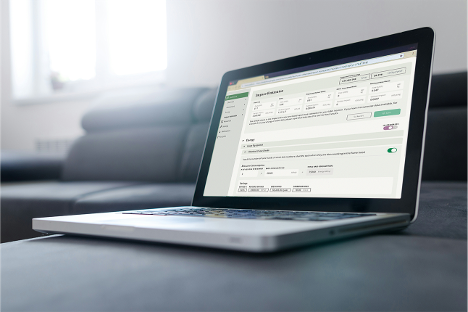
These questions helped drive the development of the Impact Estimator, a key feature within the My Green Lab Certification program designed to help laboratories quantify the environmental and financial impacts of operational sustainability improvements.
As organizations move beyond broad climate commitments and toward measurable outcomes, credible, data-driven insights are becoming increasingly important. Teams are being asked not only to reduce their organization’s environmental impact, but to also demonstrate value by justifying investments, validating time commitments, and guiding long-term sustainability strategies with reliable data.
Turning Sustainability Goals into Measurable Action
Through My Green Lab Certification, laboratories can use the Impact Estimator to understand avoided resource consumption, greenhouse gas emissions reductions, and operational cost savings resulting from sustainability actions implemented through the program.
“There is an adage in performance management you often hear: ‘You can’t manage what you don’t measure,’” says Sam Wright, Chief Operations Officer at My Green Lab. “The Impact Estimator was built around this idea – it not only quantifies the resource intensity of laboratory equipment, it also provides a granular view of the opportunities for impact reduction, and quantifies savings in units of electricity, water, or waste saved, tons of avoided carbon emissions, and of course, financial savings.”
Wright notes that one of the challenges in laboratory sustainability is the assumption that resource intensity is simply the cost of doing business.
“For a long time, labs have justified being resource intensive on the grounds that their work is critically important and their methods are necessary to the results,” he says. “The work is important, but that framing quietly assumes resource intensity is fixed, that it’s just the cost of doing business. It isn’t.”
Much of a laboratory’s impact is tied to operational practices and day-to-day decisions that can be improved without compromising scientific outcomes. According to Wright, one of the most valuable aspects of the Impact Estimator is that it makes this reality visible.
“This tool daylights how resource intensive laboratories are, and how behavior changes can reduce those impacts,” he continues.
By translating sustainability actions into measurable outcomes, laboratories gain a clearer understanding not only of where resources are being consumed, but also of how much opportunity exists to reduce environmental impact through operational improvements that are already within reach.
Another challenge, Wright explains, is that the results can often feel invisible. “The central accomplishment is to avoid emissions of carbon dioxide – a colorless, odorless, nonreactive, and common gas,” says Wright. “By translating operational changes into measurable environmental and financial outcomes, the Impact Estimator gives participating laboratories something more concrete to track, communicate, and celebrate.”
Reducing Emissions Now
Beyond measurement itself, Wright explains that the Impact Estimator helps organizations focus on one of the most important principles in sustainability: acting now.
“There is a time value to carbon. That is, emissions avoided now are worth more than emissions avoided later,” he says. “This tool enables labs to accomplish what various other mechanisms to avoid carbon emissions cannot: reducing emissions right now.”
Importantly, many of the operational improvements identified through My Green Lab Certification do not require major capital investments. Instead, they often focus on optimizing equipment usage, improving operational behaviors, and increasing resource efficiency.
“This is a program that requires little-to-no or limited capital expenditure,” Wright explains. “We’re not asking people to buy new equipment but rather to use existing equipment more efficiently.”
This operational focus is especially important for organizations seeking near-term sustainability gains without waiting for large infrastructure upgrades or capital replacement cycles.
“These efficiencies translate into substantial resource and financial savings opportunities,” Wright continues, noting that organizations can often achieve six- and seven-figure savings over time.
Built for Real-World Laboratory Operations
Lasting progress requires scientists and laboratory professionals to understand how their daily decisions affect energy use, water consumption, waste generation, and emissions. According to Wright, this focus on people is what makes laboratory sustainability such a significant opportunity.
“Even the greatest building won’t perform if the people inside aren’t part of the effort. It’s the everyday decisions of laboratory professionals in aggregate that create change,” says Wright.
“What makes working with labs so energizing is that the low-hanging fruit is everywhere. There are real, meaningful improvements available right now that make a surprisingly large difference,” he continues.
The Impact Estimator helps make those opportunities visible. The tool uses robust default assumptions to provide immediate, meaningful value while also allowing users to improve accuracy by incorporating more detailed operational information.
“Default values make it useful out of the box, but it gets better the more you engage,” Wright explains.
The tool allows laboratory teams to refine estimates by uploading more complete equipment inventories, configure lab-specific operational data, and leverage geographically specific utility information. Recently, My Green Lab expanded the geographic granularity of the tool, improving pricing and carbon intensity data from country-level averages to zip-code-level information across more than 660 cities worldwide.
This balance between accessibility and increasing precision is intentional. Laboratories can begin measuring impact immediately while continuously improving estimate accuracy as programs mature and operational engagement deepens.
My Green Lab also provides detailed user guidance to help laboratories understand how estimates are generated and how to achieve the most accurate results possible.
Scaling Sustainability
Wright also notes that many organizations are moving beyond isolated sustainability pilots and beginning to scale initiatives across entire laboratory portfolios and supply chains. As programs expand, organizations are increasingly looking for detailed data to demonstrate value across global operations.
“The Impact Estimator helps organizations justify program expansion by prioritizing high-impact actions, quantifying ROI for internal decisionmakers, and scaling those insights across whole real estate portfolios,” says Wright.
This ability to connect individual laboratory actions to organization-wide sustainability goals is becoming increasingly important as sustainability moves from a niche initiative to an operational priority across the life sciences industry.
Impact Starts at the Bench
The Impact Estimator ultimately reflects a broader philosophy that has long guided My Green Lab’s approach to sustainability in science. “The foundation of My Green Lab Certification has always been about engaging scientists at the bench,” says Wright. “It is the everyday behaviors of scientists and laboratory professionals, in aggregate, that can create change.”
Wright adds that when it comes to sustainability strategy, “data matters, and people matter.”
This approach also aligns with a growing shift emerging across the scientific industry: meaningful sustainability progress is not driven by a single technology or policy alone, but by empowering people with the tools, data, and frameworks needed to make informed decisions. As sustainability expectations continue to evolve, the Impact Estimator helps laboratories measure what matters in a credible, consistent, and actionable way.