

How Surgical Pathology Labs Can Help Build More Sustainable Healthcare
Healthcare exists to nurture and protect human health. Even so, histopathology has one of the highest carbon footprints per test, with emissions estimated at ~280–790 g CO₂e per sample, higher than many routine clinical chemistry tests (0.5 and 116 grams CO₂e per test).1 Hospitals and laboratories require energy-intensive infrastructure, complex supply chains, chemicals, consumables, long-term cold storage, specialized equipment, and highly regulated waste disposal. As climate change increasingly affects public health and healthcare resilience, the scientific and medical communities are being asked to look inward at the environmental impacts of their own work.
For surgical pathology laboratories, this conversation is complex but workable with a transition to greener pathology workspaces.
Pathology plays a central role in modern healthcare systems. It examines tissue/cells to guide treatment decisions, supports surgical and cancer care, determines disease progression and supports precision medicine. At the same time, surgical pathology is resource-intensive by design. Tissue must be collected, transported, fixed, processed, embedded, cut, stained, scanned, long-term archived, and often tested further using immunohistochemistry, molecular assays, or other ancillary techniques. Each step carries material resources, chemical, energy, and waste implications.
This is where the concept of green pathology becomes so important.
In their recent review, “Green-path: planting seeds for environmental sustainability in diagnostic and research surgical pathology2,” Alessandro Gambella, Federica Grillo, and co-authors frame green pathology as a next evolution of pathology’s existing commitment to quality and safety in the healthcare system. The goal is not to compromise diagnostic accuracy or patient safety, rather, it is to examine how pathology can continue delivering excellent care while reducing unnecessary environmental impact.
This distinction is important. For many pathology professionals, the first reaction to sustainability is often concern: Will this make the work harder? Will it interfere with quality? Will it add another burden to already stretched teams?
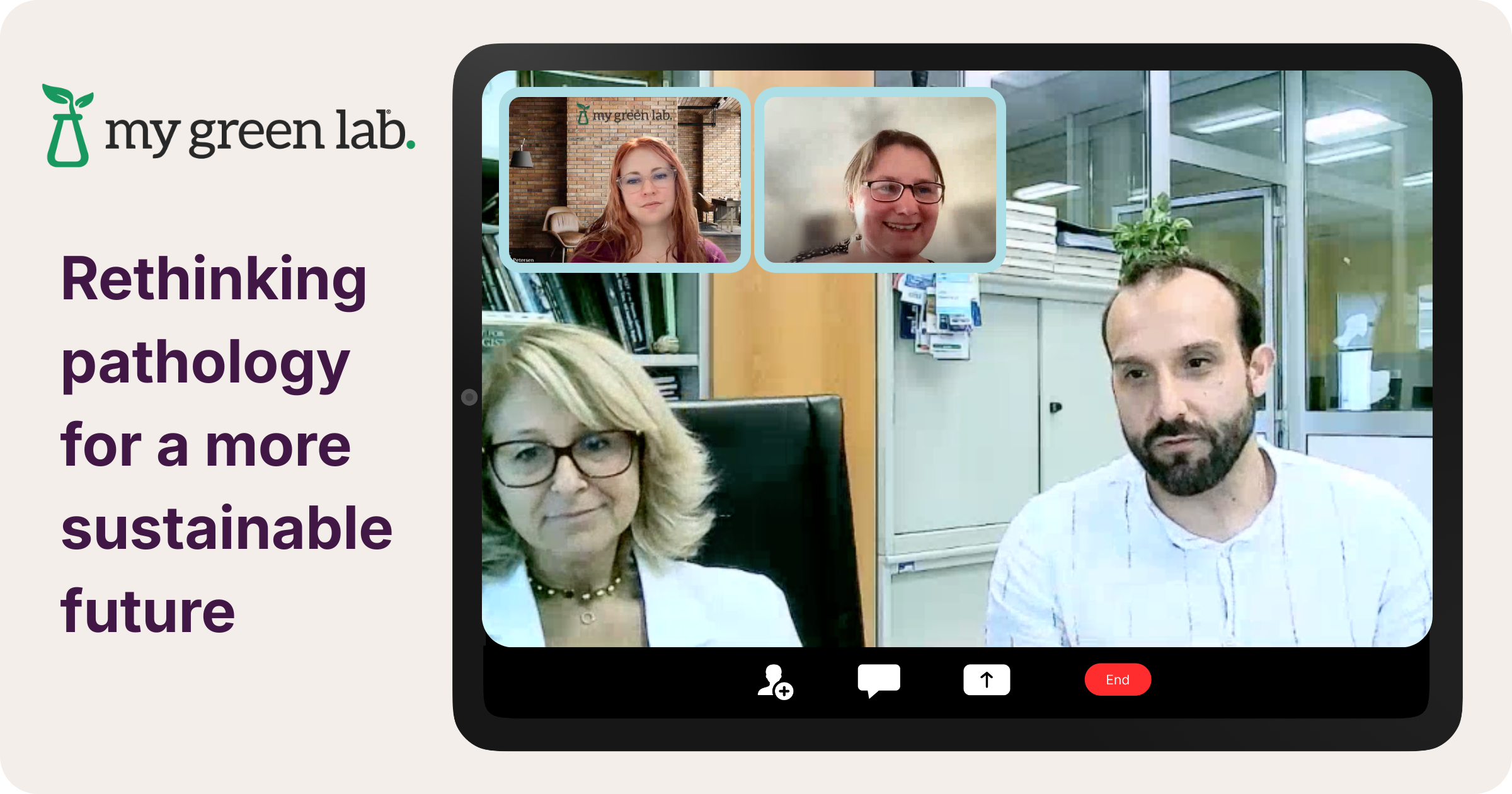
Thankfully in Gambella’s and Grillo’s experience, a more hopeful starting point already exists in many laboratories. In a recent conversation with members of the My Green Lab® team, they shared how their own laboratory began uncovering small but meaningful sustainability practices that were already taking root in daily workflows.
The journey: from scientific review to real-world laboratory change
The idea for the review began after Alessandro Gambella attended a session on sustainability and green pathology at the European Congress of Pathology in Vienna. Gambella and Grillo, both surgical pathologists and university professors at the University of Genoa, began discussing what these ideas could mean in their own laboratory setting.
They quickly noticed that surgical pathology needed its own sustainability conversation. Its environmental challenges are shaped by highly regulated diagnostic processes, time-critical specimen workflows, long-term storage requirements, workforce and budget shortages, digital pathology demands and the need to maintain diagnostic accuracy in a skilled discipline where every patient sample carries significant clinical consequences.
However, when they began looking closely at their own workflows, they quickly realized sustainability was not entirely new to their team.
“There were some seeds already there,” they shared in conversation with My Green Lab. Staff members were already finding small ways to save reagents, reduce unnecessary use of consumables, or improve efficiency. Because of working in silos, many simply had not been given a shared language or framework to recognize those actions as sustainability.
Green pathology does not have to begin with a major renovation, a new facility, or a large capital investment. It can begin by looking carefully at daily practice and asking where improvements can be made.
What is green pathology?
Green pathology applies sustainability principles to the processes that already define pathology, across the full diagnostic workflow and beyond the laboratory itself. That includes what happens upstream, as specimens are collected, packaged, transported, and prepared, as well as what happens downstream, from reporting and archiving to communication with clinicians and the wider healthcare system.
For surgical pathology, this work is especially important because pathologists are central to the process and stewards of the patient sample. They see from a vantage point that many others in the healthcare system do not. They understand what happens before a specimen arrives, what happens inside the lab, and how the diagnostic result informs care.
Pathologists may not control every upstream decision, but they can help shape better practices around specimen collection, container size and use, second containers and packaging, efficient transport, sampling adequacy, reporting, and repeat testing. They can also guide conversations with clinicians, procurement teams, facilities staff, and suppliers.
Start with hotspots, not a generic checklist
One of the strongest themes in the review is the importance of identifying sustainability hotspots and realizing that there is no generic solution.
Every pathology lab is different. Workflows vary by country, health care system, building design, water quality, equipment, staffing, mix of cases, regulatory environment, and local clinical needs. A sustainability intervention that works well in one pathology lab may not transfer directly to another.
As the authors explained, there is no single “magic rule” that applies to every pathology laboratory. The better approach is to know your own process, identify bottlenecks and where improvement is realistic, and start where action is most feasible.
That might mean reducing formalin use, reviewing specimen handling for appropriate container use, reducing unnecessary packaging, shifting non-urgent equipment use to off-peak hours to save energy, reducing repeat sectioning, improving inventory management, recycling solvents or strengthening waste segregation. The key is to choose actions based on the lab’s actual workflows and data.
This hotspot approach also helps prevent sustainability from feeling overwhelming. Labs do not need to solve everything at once. They can begin with targeted changes, building staff engagement and education, measuring progress, and expand from there.
The hidden footprint of the pre-analytical phase
Sustainability in pathology begins before the tissue reaches the lab.
The pre-analytical phase includes specimen collection, packaging, container selection, and transport. These steps can lock in a significant portion of a diagnostic workflow’s environmental impact before the pathology team ever begins its work.
In the interview, Gambella and Grillo described how samples may arrive in layers of packaging: a container inside a plastic bag, sometimes inside another container, sometimes surrounded by multiple additional bags.
Some packaging is necessary for safety and compliance. Some may be excessive.
The opportunity is to distinguish between regulation, what is necessary as safety protections and what has become routine without continued evaluation.
Right-sizing specimen containers, reducing unnecessary packaging and formalin use, consolidating transport routes, and improving communication with surgical units, endoscopy teams, and other clinical departments can all help reduce waste, chemicals and emissions associated with sample movement. This is also where pathologists can play an important advisory role. They understand what is needed to preserve diagnostic quality and can help upstream colleagues make better choices without risking patient care.
Chemical stewardship: formalin, solvents, and everyday awareness
Formalin is part of the daily reality of pathology. It is essential to many workflows, but it is also hazardous and creates significant waste management challenges. Because it is used so routinely, teams can become desensitized to the risks and impacts associated with it.
Grillo explained, “Formalin is basically our bread and butter,” she said. “We use formalin like it was water, but it’s toxic, it’s carcinogenic, and it’s a challenge to waste dispose of.”
Gambella pointed to the same issue in everyday practice: “You say, ‘a little bit more… it’ll fix better.’ You don’t need it.”
Green pathology brings that awareness into daily practice by encouraging teams to use only what is needed, reduce excess, validate recycling systems or less toxic alternatives where possible, and keep educating staff to feel empowered to question habits that create unnecessary chemical waste.
The “always-on” problem in pathology labs
Energy is another major area of opportunity, particularly because many laboratories operate with an “always-on” mindset.
Some equipment must remain on continuously for safety, time critical workflows, or technical reasons. Other devices may be left running out of habit.
The question becomes which devices truly need to stay on, which can enter standby mode, and which can be safely shut down completely during predictable low-use periods.
In specialized areas such as electron microscopy or digital pathology, energy considerations may be even more important because of the equipment and computing demands involved.
Digital pathology in the lab
As Grillo cautioned, “Digital pathology has got a lot of things going for it, but it’s probably not as sustainable as we would hope… you still need the slide, which has to be stained and scanned. And then obviously there’s all the computational part, which is not necessarily as sustainable as we think.”
Whole-slide imaging, data storage, scanner equipment, servers and data centers, computing infrastructure, hardware replacement, and AI models all carry environmental costs. The glass slide still must be prepared, stained, scanned, interpreted, and archived. Digitization may add steps to the workflow rather than replace them entirely.
Gambella and Grillo described this as both a caution and an opportunity. In many regions, digital pathology is starting to be implemented. That means pathology has a chance to build sustainability into the digital transition from the beginning.
AI tools may improve efficiency and expand access to pathology expertise in many regions experiencing a shortage of staff. However, they also increase computational demand and data storage requirements with their own environmental footprint.
Green pathology encourages laboratories and institutions to evaluate the net impact of these new digital tools. The goal is not to slow innovation but to explore how it can be more responsible from the beginning.
Waste reduction and the need for a circular mindset
Waste in pathology is complex because safety and contamination control are essential. Some items must be single-use. Some waste must be handled as hazardous or biohazardous. Some materials cannot be reused or recycled under current regulations or workflows.
Even with those constraints, the authors see opportunities for a more circular mindset.
Gambella emphasized, “Unless you actually have an experimentally proven thing that says, ‘I have done this and I’ve used it and it works and there was no problem with my tissue,’ then people are not going to believe you unless you show them.” This need for proof creates a research opportunity for pathology: to generate the data that shows what can safely be reused, recovered, or reduced without compromising diagnostic quality.
An easier waste opportunity is taking a closer look at the lab’s classification and segregation. Misclassified waste can increase the amount of material sent for incineration, which raises both environmental impact and hauling costs. Clear guidance and signage, staff training, audits, and feedback can help ensure that waste enters the correct stream while maintaining safety.
Why culture, frameworks and certification matter
Green pathology can begin with small actions, but long-term progress requires structure and a culture shift.
When they began speaking with technicians and pathologists about sustainability initiatives, Gambella and Grillo found more interest than expected. Some staff were already reducing waste or saving reagents in small ways. Others had ideas that had never been shared across the full team. Monthly quality meetings became a place to introduce sustainability, gather input, and connect isolated good practices into a more structured program.
Frameworks such as Environmental Management Systems, ISO standards, and My Green Lab Certification can help laboratories move from individual ideas to measurable, systematic change. They provide a way to identify impacts, set priorities, track progress, and ensure that important areas are not missed.
“From our side, we know the process, but we are not experts in the field of sustainability,” Grillo explained, “We can be enthusiastic, but then what we had at the beginning was, how do we measure that? Having a framework, or trying to follow a certification, gives you the tools and the expertise to do that in a proper way, in a systematic way. And by having a certification, you know which other labs have a certification. You make a network where you share your expertise, your information, and your daily work.”
Green pathology is healthcare resilience
The encouraging lesson from Gambella, Grillo and their colleagues is that this work is both possible and within reach. And like most culture shifts in science, it begins with people looking at the work they already do and realizing that the ability to implement change may already be available to them.
Referenced sources:
- McAlister, Scott, Alexandra L. Barratt, Katy J.L. Bell and Forbes McGain. “The carbon footprint of pathology testing.” The Medical Journal of Australia, May 2020, 212(8): 377-382. doi: 10.5694/mja2.50583. https://pubmed.ncbi.nlm.nih.gov/32304240/
- Gambella, Alessandro, Simona Pigozzi, Michele Paudice, Roberto Fiocca, Luca Mastracci and Federica Grillo. “‘Green-path’: planting seeds for environmental sustainability in diagnostic and research surgical pathology.” Virchows Archiv, April 25, 2026. doi: 10.1007/s0 https://pubmed.ncbi.nlm.nih.gov/42032136/