

How Eppendorf responded to growing procurement demands for verified sustainability data and prepared for mandatory ESPR requirements.
As sustainability requirements intensified across the life science industry, Eppendorf faced a growing volume of customer tenders requesting detailed product sustainability data. Responding to these requests was timeconsuming, and without a standardized reporting framework, communicating the company’s sustainability credentials credibly was a challenge. At the same time, regulations such as ESPR were moving from discussion to implementation, requiring Eppendorf to build structured internal data capabilities ahead of mandatory requirements.
Growing volume of customer requesting detailed sustainability data
A growing need for measurable, defensible results
Preparing for upcoming regulatory requirements such as ESPR
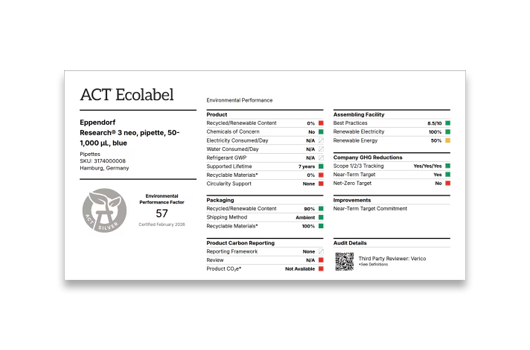

Eppendorf began its ACT Ecolabel journey in 2017, starting with products where energy efficiency and sustainable cooling were already customer priorities. Following early success, the company’s board committed to achieving at least one ACT Ecolabel per product group. The program expanded progressively across product lines, with more complex instruments added under ACT Ecolabel 2.0.
Internally, the certification transformed how R&D and product management teams approach development. Teams now proactively factor sustainability attributes (material origin, recycled content, recyclability, supply chain distances) into design from the outset. This shift was driven by clear commercial understanding: the ACT Ecolabel has a measurable positive impact on sales. The label moved from a compliance exercise to a visible connection to market performance. The Research 3 neo pipette’s fully recyclable packaging exemplifies this transformation with 100% recycled fiber cardboard designed from the start with ACT awareness.
Products ACT Ecolabel Certified
Supporting big pharma producrement
Enabling customer Scope 3 emission data
My first reaction in 2017 was ‘what a long list of questions.’ But ACT Ecolabel serves two purposes: meeting current customer requirements while preparing for ESPR. We’re seeing strong demand from pharma customers. It’s been our warm-up session before the heavy-duty regulations arrive.

Eppendorf’s experience demonstrates that voluntary certification programs like the ACT Ecolabel deliver value well beyond marketing. By building the internal data infrastructure, cross-functional processes, and product-level sustainability documentation that ACT Ecolabel certification requires, companies are simultaneously preparing for the mandatory reporting and product requirements that frameworks such as ESPR will impose.
For manufacturers and suppliers in the life science sector, the question is no longer whether detailed sustainability data will be required. It’s how quickly they can develop the capability to provide it. ACT Ecolabels offer a structured, credible, and scalable way to start that journey now, with business benefits that are already tangible in customer relationships and competitive positioning.