
The freezer is part of the climate story
Every laboratory has a freezer story: the ultra-low temperature (ULT) unit tucked into a corridor because the lab ran out of room, the backup freezer that quietly became permanent storage, the box of legacy samples no one feels authorized to discard, or the researcher who can find a critical sample only because the location lives in memory rather than in a system. These stories are familiar because they are common. They are also increasingly difficult to ignore.
As laboratories work to reduce environmental impact, improve resilience, and make better use of research space, cold storage deserves close scrutiny. Freezers, refrigerators, liquid nitrogen systems, and walk-in cold rooms protect materials that may represent years of scientific effort and patient contributions. But when storage is poorly managed, these same assets quietly consume space, energy, capital, and scientific time.
As organizations seek to manage and reduce these impacts, an important question emerges: how much of the perceived need for additional storage capacity, energy consumption, capital investment, and researcher effort is driven by genuine demand versus gaps in visibility, governance, and stewardship?
To explore these drivers, we conduct cold storage assessments across a range of life science organizations to better understand how cold storage is being used in active research environments and, more importantly, to help identify practical ways to address current obstacles and pain points. The work includes reviews of cold storage units and utilization, observations of storage workflows, and discussions with scientists, laboratory managers, facilities teams, operations groups, and leaders. The purpose is to understand what materials are being stored, where they are located, how effectively existing capacity is being used, and where gaps in visibility, governance, or process could create risk, inefficiency, or unnecessary burden for research teams.
This work reflects a simple premise: samples are the foundation of scientific discovery, and effective cold storage management should help researchers protect and access those materials more efficiently. Many of the practices applied in these assessments reflect approaches used within Azenta’s own repository operations, adapted for the realities of active research laboratories. The goal is not to limit control or create barriers, but to improve organization, stewardship, and efficiency while preserving the ready access scientists need to do their work.
Findings are shared as practical, data-driven recommendations to improve sample stewardship, utilization, sustainability, resilience, and scientific productivity. Organizations may choose to address these opportunities through changes in workflows, governance, technology, services, or infrastructure; however, the assessments are intended to provide objective findings and options, with no requirement to purchase additional products or services or act on any recommendation.
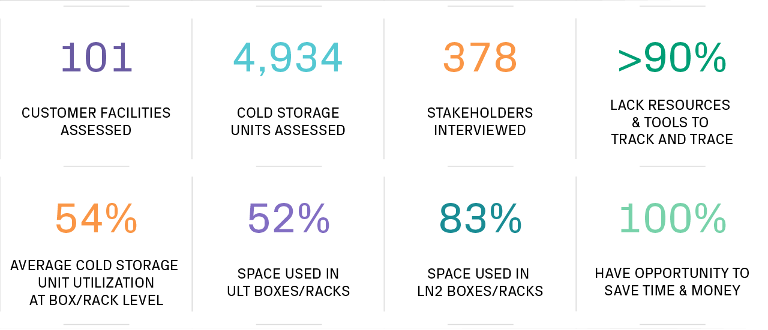
Across assessments of 101 life science facilities, 4,934 cold storage units, and interviews with 378 stakeholders that included scientists, laboratory managers, facilities professionals, operations teams, and senior leaders, a consistent finding emerged: most organizations are challenged by visibility, governance, and stewardship rather than storage shortages. Better storage management can improve science along with sustainability by unlocking existing capacity, reducing avoidable energy use, lowering risk, and reallocating researcher efforts.
Storage management is bigger than equipment
Cold storage is often treated as a collection of individual units owned by individual laboratories. This may work for small organizations, but becomes inefficient as research programs expand, personnel change, studies end, and new scientific platforms generate large, diverse biological material collections.
Scientists view storage through the lens of access and continuity. ‘Can I find what I need?’ ‘Can I trust that materials are properly maintained?’ Facilities teams focus on uptime, maintenance, emergency response, and infrastructure capacity. Finance teams see rising operating and capital costs. Leaders increasingly see the connection to sustainability, space planning, risk, and organizational resilience. Better storage management unites these perspectives into one operating model.
A freezer is not merely a piece of equipment. It is part of a biological asset management system. When that system lacks visibility, organizations may purchase additional units while underused capacity already exists. They may carry environmental burden without realizing how much is avoidable. They may retain samples indefinitely because ownership and disposition authority are unclear.
The hidden capacity challenge
One of the clearest assessment findings was the difference between perceived and usable capacity. Freezers often looked full, yet closer evaluation revealed multiple areas of underutilized space.
Across the assessment portfolio, average utilization was only 54% at the box or rack level while 52% of the available box space was being used in ULT freezers. These findings highlight a paradox: laboratories feel storage-constrained while significant underused capacity remains trapped inside existing units.
Underutilized space is a sustainability issue in that energy and space are unnecessarily consumed. By improving utilization of the cold storage units in our labs today and rationalizing materials, organizations can reduce equipment costs and space requirements, improve emergency preparedness, and align storage infrastructure with actual scientific need.
Centralized cold storage resources such as shared freezer rooms, institutional repositories, managed sample storage rooms, or automated storage platforms can further improve utilization by moving materials that are not routinely used in active work out of individual lab freezers and into purpose-designed environments that maximize storage density per square foot/meter. These shared resource areas maximize vertical space that is difficult to capture in standard lab freezers through the use of taller, automated systems that are not constrained by a person’s typical working height. With managed retrieval and automated consolidation, workflows can recover capacity that is otherwise lost within the laboratory footprint while maintaining controlled access to samples.
Figure 1. Cumulative Better Storage Management assessment findings across multiple customer facilities, cold storage unit audits, and stakeholder interviews.
Scientists are losing time to inventory inefficiency
The interviews also reinforced an underestimated sustainability point: inefficient storage management consumes time. Researchers described multiple time-consuming activities and workarounds because formal systems were incomplete or inconsistent, losing approximately two hours per week to inventory-related inefficiencies. Across a department, institute, or global research organization, this is a substantial productivity loss as time is not spent on high-value activities.
Better Storage Management supports both sustainability and scientific excellence. With findable samples, accurate records, and clear material ownership, scientists spend less time managing the past and more time generating the future.
Technology helps, but governance makes it work
Technology such as inventory management systems is a common response to storage challenges, yet software alone does not solve poor governance. More than 90% of assessed researchers lacked effective tools for cold storage material tracking and tracing, and many organizations relied on enterprise systems, spreadsheets, handwritten records, and local workarounds.
The strongest programs paired tools with clear rules that defined sample ownership, information capture, location maintenance, material reviews, disposition approvals, and procedures for staff departures. These governance elements are often the difference between sustainable operations and growing storage burdens.
Without governance, organizations lose confidence in their inventories. Backup units become permanent archives, loaner freezers remain in service indefinitely, samples move without clean location records, and leaders lack reliable data to act on sustainability goals.
Change management is critical because governance depends on consistent adoption by the people who generate, store, move, and use samples. New expectations for ownership, labeling, location updates, review cadence, and disposition often require shifts in long-standing laboratory behaviors, and adoption is more likely when these changes directly address scientists’ current pain points, including difficulty finding samples, lack of confidence in records, limited freezer space, unclear ownership, or time lost managing legacy materials. Clear action plans help manage this transition by defining what will change, who is accountable, how decisions will be made, what support is available, and how progress will be measured. Clear communication, practical support, and minimal disruption help make the process as frictionless as possible. They also reinforce that better storage practices protect sample value, preserve access, and reduce avoidable burden rather than add administrative work.
From storage ownership to biological asset stewardship
The assessments point toward the need for a broader cultural shift from storage ownership (‘Whose freezer is this?’) to biological asset stewardship (‘What is the value, purpose, accessibility, risk, and environmental cost of the materials we are preserving?’) This distinction changes the conversation.
Stewardship treats samples as lifecycle assets that are acquired, characterized, used, shared, archived, transferred, and eventually dispositioned. Each step should have standards, data, accountability, and a clear connection to scientific purpose. Managed this way, sample storage becomes a strategic enabler rather than a passive accumulation point.
In addition to supporting consistent research operations, centralized or better-governed storage models can provide access to reliable infrastructure and reduce uneven backup capacity, even for smaller laboratory groups.
Knowing what you have enables better stewardship
Good stewardship begins with knowing what is being stored where, who owns it, and how often it is accessed. This helps distinguish active research materials from strategic archives, legacy collections, and items with no scientific, regulatory, legal, or intellectual property value. Materials with no defined retention requirement may be dispositioned, while those with defined value that are rarely accessed may be better suited for managed off-site storage. Both approaches can help save laboratory space and reduce energy consumption.
Making storage decisions based on data rather than caution reframes cleanout from a one-time event into an ongoing stewardship practice. Regular reviews of inventory, retention status, and access patterns help keep active materials close to the science and retained materials protected.
A sustainability opportunity hiding in plain sight
For organizations pursuing My Green Lab Certification, the Freezer Challenge, or broader environmental goals, cold storage optimization is a tangible opportunity. ULT freezers and related cold storage assets are highly energy-intensive laboratory resources. Reducing avoidable demand can create measurable environmental benefits without compromising science.
In many cases, the greatest gains come from improving the operating model rather than upgrading equipment: consolidating or retiring equipment, maintaining and defrosting units, tracking utilization, using fit-for-purpose storage conditions, and reserving managed storage environments for long-term or rarely accessed materials.
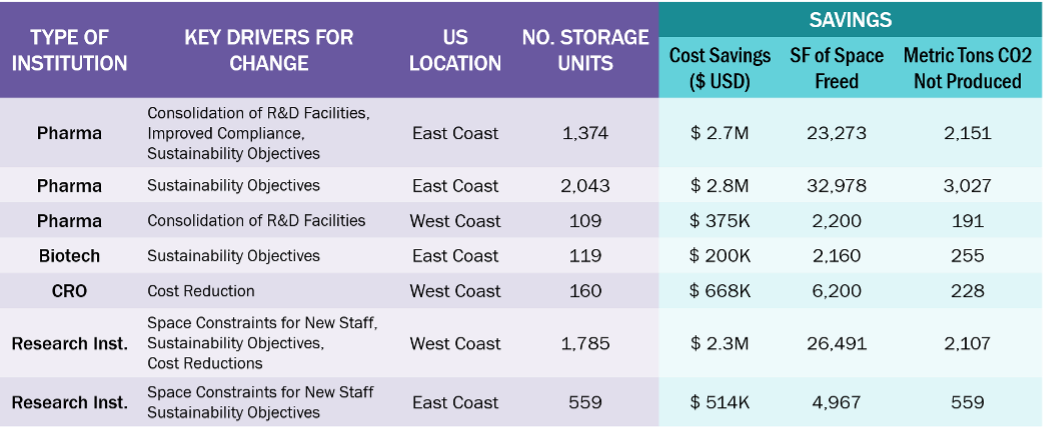
Financial opportunities are equally compelling. In our case studies, institutions identified potential savings ranging from approximately $180,000 to $2.7 million through lower operating costs and avoided capital replacement, along with opportunities to recover up to 33,000 square feet of valuable lab space.
Table 1. Achievable savings based on location and number of cold storage units
A well-designed storage program can also strengthen business continuity by allowing organizations to plan backup capacity more intelligently and create shared, transparent, and more sustainable risk management models.
The greenest freezer is often the one you do not need to buy, power, maintain, or back up in an emergency because you have made better use of the capacity you already have.
The biggest barriers are labor and change management
One of the largest barriers to Better Storage Management is often closing the information gap. When inventorying collections with mixed formats, inconsistent records, handwritten labels, legacy boxes, and accumulated materials, the labor-intensive effort to create a reliable baseline can seem overwhelming.
Emerging tools are beginning to change that equation. Automated imaging, data capture, and recognition technologies can convert physical storage content into usable digital records, even when collections include handwritten labels or incomplete documentation, reducing the burden of manually building an inventory, accelerating gap closure, and making large-scale storage optimization more feasible.
Another major barrier is change management. Scientists may reasonably worry that consolidation, cleanout, or shared storage could reduce material access, control, or integrity. Structured change management can address how Better Storage Management protects science through early engagement, clear and frequent communication, defined decision rights, and pilot testing of new workflows.
Combining practical automation with intentional culture change makes storage optimization less of a one-time cleanout and more about building a sustainable operating model. With the right practices around visible materials, clear ownership, and supported retention decisions, scientists can trust the system.
Practical actions for laboratories and institutions
Better Storage Management, which includes identifying time and money saving opportunities, doesn’t require a large-scale transformation. Many successful programs start with a baseline inventory assessment, box, rack, or shelf level utilization measurement, and legacy collection reviews to identify materials for archive, transfer, or disposition.
Institutions can also establish routine cleanout cadences, standardize minimum data requirements, clarify offboarding processes, and create leadership-approved disposition rules.
Notably, the most effective programs are cross-functional, with scientists, facilities and sustainability teams, finance, and leadership each bringing their unique perspectives and skill sets to the program.
Better Storage Management is better science and better sustainability
Cold storage management is a highly practical and underleveraged opportunity, as demonstrated by the consistent gaps identified in our stakeholder interviews. Better Storage Management helps scientists and organizations oversee their samples more intentionally.
Additionally, the sustainability message is clear: better use of existing capacity can reduce costs, energy use, and ongoing labor burdens. By pairing data, governance, technology, and change management, organizations can reduce environmental impact while strengthening scientific discovery.
In a research environment where every square foot, kilowatt-hour, dollar, and scientist hour matters, organizations can leverage Better Storage Management as a strategic sustainability practice, a productivity lever, and an approach to responsible biological material stewardship that enables discovery.
This is a guest article submission written by Katheryn Shea, Azenta Life Sciences, Inc.